What Is FinOps for Data Cloud Platforms?

The days of applying FinOps solely to public clouds are over. Data cloud platforms use consumption-based pricing tied to activity, which makes costs variable and often unpredictable. Query runs, pipeline schedules, and the consumption of virtual currency units such as Snowflake Credits and Databricks Units (DBUs) drive overall spend. This results in inefficiencies such as idle compute, over-provisioned warehouses and unoptimized queries that waste resources.
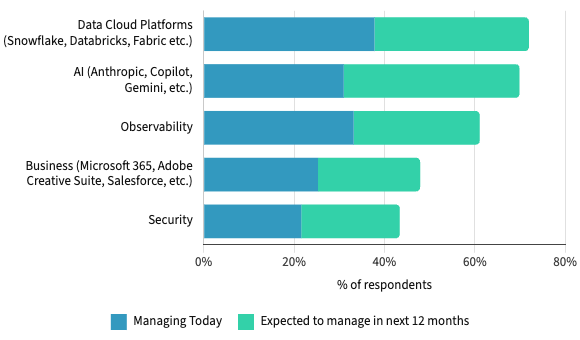
The State of FinOps 2026 report finds that 37.8% of FinOps teams are already managing data cloud platforms today. That is expected to grow by an additional 34.2% in the next 12 months.
In this article, we’ll explore what FinOps for Data Cloud Platforms is, who is involved, and what types of tools exist.
Table of Contents
FinOps for Data Cloud Platforms, Defined
FinOps for data cloud platforms applies the FinOps Framework to consumption-priced data and analytics platforms. Snowflake, Databricks, BigQuery, Amazon Redshift, and Microsoft Fabric all qualify. Costs come from queries, pipelines, and virtual currency units rather than provisioned servers. The work centers on workload efficiency instead of infrastructure procurement.
The FinOps Foundation defines FinOps as follows:
“FinOps is an operational framework and cultural practice which maximizes the business value of technology, enables timely data-driven decision making, and creates financial accountability through collaboration between engineering, finance, and business teams.”
– FinOps Foundation Technical Advisory Council
Updated: March 2026
Note the word technology. Earlier definitions said cloud. That single edit opened the door to the framework’s technology categories. Alongside public cloud, they now include data platforms, SaaS, private cloud, data centers, licenses, and artificial intelligence (AI).
How the FinOps Lifecycle Applies to Data Clouds
The FinOps lifecycle follows three phases: Inform, Optimize, and Operate. At a high level, the Inform phase focuses on cost visibility and allocation, the Optimize phase focuses on improving efficiency, and the Operate phase focuses on how teams take action and collaborate. FinOps Capabilities, such as budgeting, unit economics, and usage optimization, to name a few, are aligned with the phases. Teams are encouraged to take an iterative approach in moving maturity forward for each capability.
Inform means query-level attribution instead of tags. Get this wrong and every later phase inherits the error. Engineers will not act on a number they do not trust.
Optimize shifts from rate to usage. The 2026 framework renamed Workload Optimization to Usage Optimization, and the rename lands hardest here. On public cloud, commitments buy real savings. On data clouds, commitments discount credits you should not be burning. The savings live in auto-suspend values, warehouse sizes, queries that stop spilling, and pipelines that stop rerunning unchanged work. We break the pipeline side down in our pipeline efficiency framework.
Operate means guardrails instead of cleanups. Scheduling policies, scaling limits, and resource monitors keep the gains from eroding. They erode fast without them. One new dashboard or one rescheduled dbt run can undo a quarter of tuning, and nothing tells you it happened.
Who Owns Data Cloud FinOps
Traditional FinOps personas still apply. Data clouds add people who never appear on a public cloud cost review.
Let’s look more closely at the key stakeholders for FinOps for Data Cloud Platforms:
| Persona | What They Control |
|---|---|
| Data Engineer | Query patterns, pipeline schedules, and transformation logic |
| Platform Administrator | Warehouse configuration, scaling policy, and access guardrails |
| Data Scientist and Machine Learning engineer | Training and inference workloads, the fastest-growing line item |
| FinOps Practitioner | Allocation model, reporting cadence, and cost governance |
| Chief Data Officer | Cost and performance trade-offs at the portfolio level |
| Finance | Budget, forecast, and commitment strategy |
Each of these personas has a distinct role, but the most successful FinOps practices are collaborative across teams.
What Types of Data Cloud FinOps Tools Exist?
FinOps tools fall into three categories: native provider tools, third-party vendor tools, and homegrown (DIY) tools.
Native Tools
Native tools come directly from data cloud providers such as Snowflake or Databricks. They are often bundled into larger platform agreements or spending commitments, and are easily available at no extra charge.
These tools are useful for teams that are just getting started because they provide baseline visibility into spending and usage. However, they are retrospective, geared at reporting on what has happened, rather than enabling real-time optimization. When enterprises need more proactive cost control and automation, they often grow out of native tools.
Third-Party Tools
Third-party tools are developed by independent companies such as Keebo. Many of these vendors are members of the FinOps Foundation ecosystem.
This category includes two sub-segments.
The first is traditional cloud FinOps platforms. These tools ingest billing and usage data from multiple cloud providers to give teams a unified view of total technology spend. They focus on visibility, reporting, allocation, and financial governance across multi-cloud environments. These platforms are built for breadth.
The second is a fast-growing subset of tools that are purpose-built for data cloud platforms. These solutions go deeper into systems like Snowflake and Databricks and focus on workload-level insights. Within this sub-segment, some vendors prioritize broad platform coverage with visibility and recommendations, while others focus more heavily on optimization and automation.
Most enterprises run both. The platform answers what the organization spent. The optimization tool changes what it spends next.
Homegrown Tools
Homegrown tools, also referred to as DIY or build-your-own solutions, commonly rely on spreadsheets, BI tools like Looker or Tableau, and custom scripts.
While homegrown tools offer flexibility and full customization, they come with significant tradeoffs. The time and investment needed to build, the ongoing maintenance, and the drain on engineering resources can quickly become a burden. Over time, these tools become difficult to scale and shift focus away from core product or or data initiatives, leading to inefficiencies and potential setbacks in achieving strategic goals.
This approach is rarely worth it unless developing and maintaining software is your company’s primary concentration.
Instead, it’s recommended to implement a buy and build approach, where you buy a tool that meets 80–90% of your needs and then build customizations on top of it.
How Keebo Enables FinOps for Data Cloud Platforms
FinOps for Data Cloud Platforms requires continuous optimization at the workload level, where most cost and performance inefficiencies occur. Keebo addresses these challenges by providing autonomous warehouse optimization and workload intelligence across queries, storage, warehouses, and data health.
Instead of stopping at visibility, Keebo continuously analyzes usage patterns and workload behavior in Snowflake and Databricks to identify inefficiencies in real time. It then automatically adjusts warehouse configurations according to performance guardrails you establish, ensuring optimizations remain within the performance and reliability criteria you set.
This approach reduces idle compute, improves resource utilization, and helps teams maintain more predictable data cloud costs without manual tuning.
Frequently Asked Questions
What Does FinOps Stand For?
FinOps combines finance and DevOps. It is a cultural practice and operational framework for maximizing the business value of technology spending. It does not mean financial operations.
How Is Data Cloud FinOps Different From Cloud FinOps?
Cloud FinOps manages infrastructure spend on compute, storage, and networking, and leans on commitments for savings. Data cloud FinOps manages consumption inside platforms like Snowflake and Databricks, where queries and pipelines drive cost. Savings come from workload efficiency rather than procurement. They are similar in that both provide billing volatility and require a dedicated practice for effective management.
What Tools Are Used for FinOps in Snowflake or Databricks?
Teams typically choose from native provider tools, third-party FinOps tools, and homegrown tooling. Native tools provide baseline cost visibility, while broader FinOps tools help with reporting and allocation across environments. Some organizations also use specialized data cloud optimization tools that focus on workload-level insights and automated efficiency improvements.
Is FinOps Only About Cost Reduction?
No. FinOps is focused on maximizing the business value of technology spend, not minimizing it. In data cloud environments, this includes improving performance, increasing efficiency, and ensuring teams can scale workloads effectively while maintaining cost control.
How Do I Start FinOps for Snowflake or Databricks?
Measure idle compute first to size the problem. Then fix attribution so every credit has an owner. Then set guardrails so the gains hold. Read our Snowflake vs. Databricks comparison guide for more optimization best practices.