Keebo: Revolutionizing Warehouse Optimization with a Technical Lens

Data teams must deliver fast insights while controlling costs. Fixed Snowflake configurations force trade-offs between performance and cost.
Keebo balances both. Our six-layer framework optimizes Snowflake without trade-offs. Here’s how it works.
How to address modern data warehouse challenges—with no compromises
Snowflake warehouses power analytics but remain difficult to manage. Need fast query speeds for real-time decisions? That often requires scaling up and increasing costs. Lower costs can reduce performance and frustrate users.
We built a solution that eliminates these trade-offs. It adapts to workloads and improves performance and cost efficiency.
The six-layer framework is not optional or modular. It targets inefficiency at its core. Each layer builds on the last to fit your business.
Layer 1: Configuration Schedules – Aligning Resources with Needs

Configuration Schedules align warehouse resources with predictable workloads like weekly ETL jobs. For example, let’s say you’re running a resource-intensive ETL job every Sunday night, consolidating large datasets like sales figures, customer interactions, or inventory updates from the past week.
Keebo automates scaling and lets you set parameters for each schedule. You can set a larger warehouse size, adjust the minimum and maximum number of clusters for efficient scaling based on workload demands, and even enable or disable specific optimization algorithms to tailor Keebo’s behavior precisely to your needs. This ensures smooth ETL performance under heavy load. After completion, Keebo reverts to default settings to save resources.
For other recurring tasks like daily reporting, you can define different parameters—such as a smaller warehouse size with minimal clusters—to prioritize cost efficiency. Across all schedules, you maintain precise control over which algorithms to enable or disable, ensuring Keebo’s optimization mechanisms align perfectly with your goals. This combination improves performance across all workloads.
Layer 2: Sliders – Empowering You to Define Your Goals
Sliders let users define optimization priorities. Sliders control performance, cost, or balance.
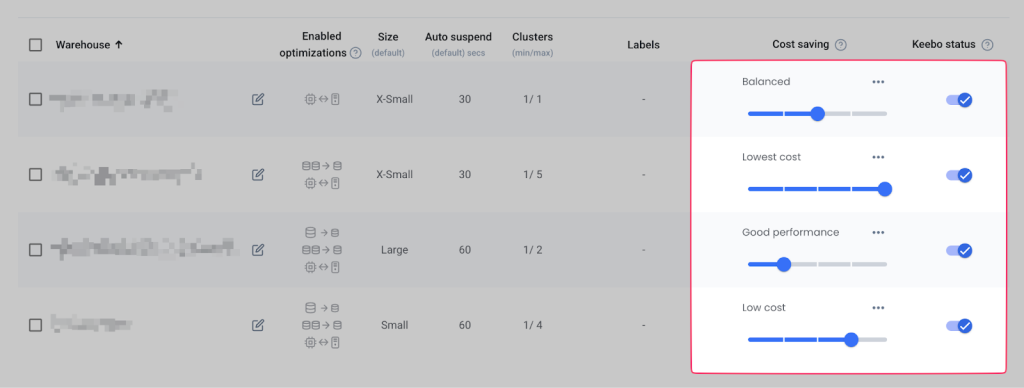
Keebo algorithms self-tune to match your goals. This lets you control optimization aggressiveness ensuring that our system aligns perfectly with your business needs. We’ve designed this feature to give you intuitive control, so you can focus on your outcomes while we handle the complexity of optimization.
Layer 3: Performance Guardrails – Protecting Your SLAs
Performance Guardrails help you meet SLAs. Keebo monitors metrics in real time and reverts if thresholds are breached.
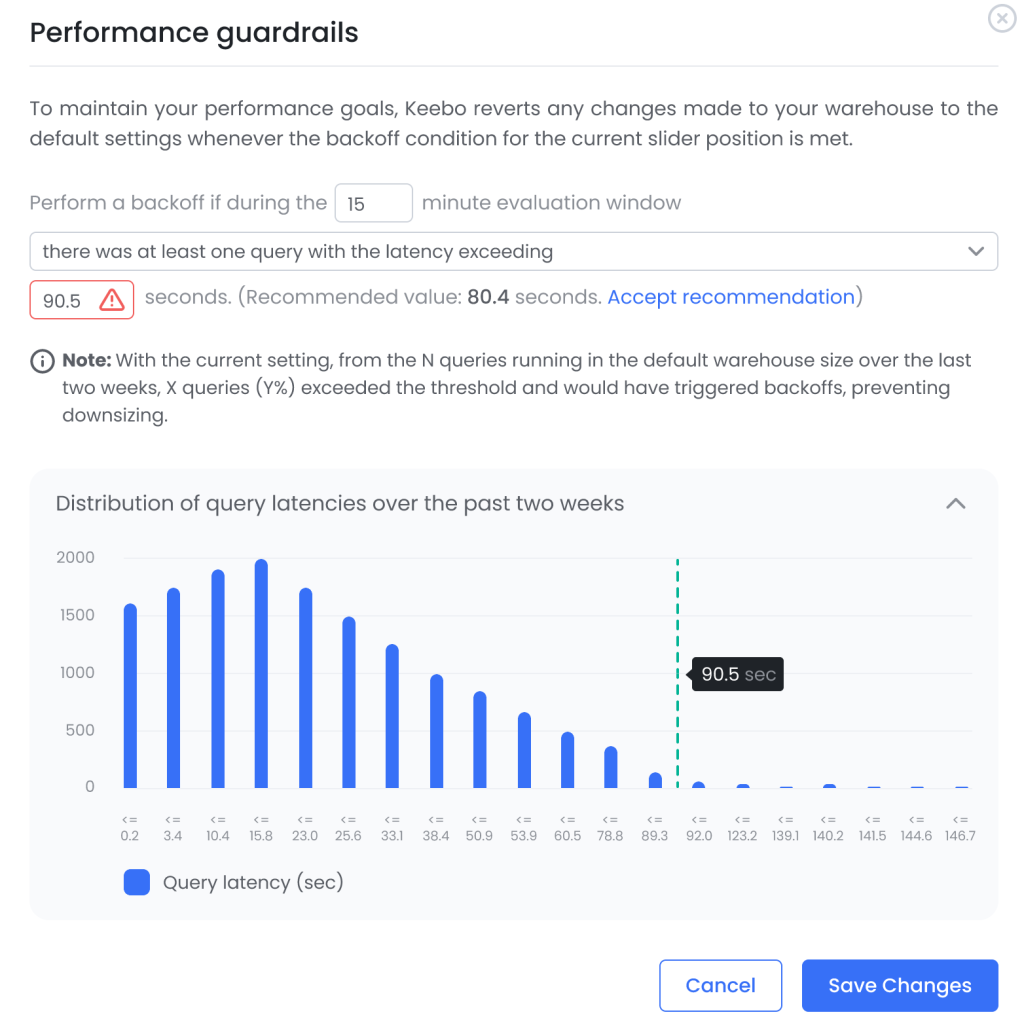
You can define your SLAs with precision using metrics like maximum latency – where we perform a backoff if any single query exceeds the latency threshold, ensuring your workloads do not experience unacceptable delays. Similarly, we track maximum queue size, which, when triggered, executes a backoff if the number of queries waiting in the queue exceeds your specified limit at any point. Additionally, our maximum queue time metric ensures that if any query waits in the queue longer than your defined threshold, we take action to restore performance.
Guardrails let you define standards per warehouse. Keebo works diligently to maintain them.
Layer 4: Condition-Based Upsizing – Scaling with Intelligence
Workload spikes can strain systems. Condition-Based Upsizing manages spikes proactively. This layer uses real-time metrics to trigger scaling rules.

For instance, if query latency exceeds a threshold you’ve set—say, 100 seconds during a sudden surge in dashboard usage—Keebo will automatically increase the warehouse size to meet the demand, ensuring smooth performance for your users. During each optimization cycle, Keebo evaluates your rules and upsizes the warehouse, up to a maximum number of levels you specify, whenever the condition is met. When the spike subsides and the condition no longer applies, Keebo scales the warehouse back down—either by one level or to your default size, based on your preference.
You can set default parameters and rely on dynamic scaling during spikes. This improves efficiency while avoiding overprovisioning and excess cost.
Layer 5: Optimization Algorithms – Stability with Precision
We’ve already discussed how our scheduling features let you align warehouse resources with your workload demands, offering tailored control over optimization settings. The fifth layer takes this a step further by enabling you to fine-tune Keebo’s behavior across all schedules.
You can enable or disable specific optimization algorithms, like Automated Downsizing or Multi-Cluster Optimization, to ensure Keebo’s mechanisms align perfectly with your operational goals.
For critical operations, like a monthly ETL pipeline that processes large datasets to update your financial reporting systems, this layer provides unparalleled control. You may choose to disable Automated Downsizing during this pipeline to prevent any risk of resource reduction, guaranteeing stability when reliability is non-negotiable. Once the pipeline completes, Keebo automatically re-enables the algorithm for regular operations, maintaining efficiency without manual intervention. This precise risk management blends automation with detailed customization, helping your warehouse deliver consistent performance across diverse workloads.
Layer 6: Smart Query Routing – Efficiency and Performance in Harmony
Finally, smart Query Routing dynamically directs each query to the right-sized warehouse on the fly. Our routing algorithms autonomously account for warehouse size, current load, and the query’s own characteristics when making decisions. This ensures both cost efficiency and optimal performance without any manual intervention.

A common use case for query routing occurs when lightweight queries run on oversized, expensive warehouses. At the same time, heavier queries are routed to appropriately sized warehouses to avoid delays.
By grouping similar queries together, each warehouse handles a more consistent workload, making it easier for Keebo’s AI to apply real-time optimizations effectively.
This approach delivers multiple benefits:
- Reduce costs by preventing overprovisioning
- Boost query performance by automatically routing high-priority or heavy queries to larger or underutilized warehouses, preventing SLA violations and ensuring light queries aren’t delayed by more demanding ones
- Free your data team by decoupling application logic from performance concerns, letting them focus on writing accurate queries while Keebo handles selections of the best warehouses for query processing.
Why Keebo Wins: Built for Data Teams, by Data Experts
Keebo isn’t just a product. It’s a platform crafted to solve the full range of warehouse headaches. Automation, customization, and real-time insights come together so your team can focus on analytics, not infrastructure.
The proof? 95% of our customers achieve their goals with minimal setup, and our full framework scales to handle even the toughest workloads.
At Keebo, we’ve distilled deep technical know-how into a platform that’s both powerful and practical. We’re not just optimizing—we’re evolving with your business, adapting as your needs grow.