
Data Lake vs. Data Warehouse: What’s the Difference?

Modern data cloud architectures import, query, transform, and analyze diverse data types. Many organizations run hundreds of thousands of queries daily. Data teams must choose between a data lake and a data warehouse based on workload needs.
Each approach has trade-offs. The right choice depends on your use cases and priorities. This article explains each approach so you can make the right decision.
What is a data warehouse?
Data warehouses are centralized systems that store large volumes of structured and semi-structured data. The goal is to make data retrieval and analytics faster and easier.
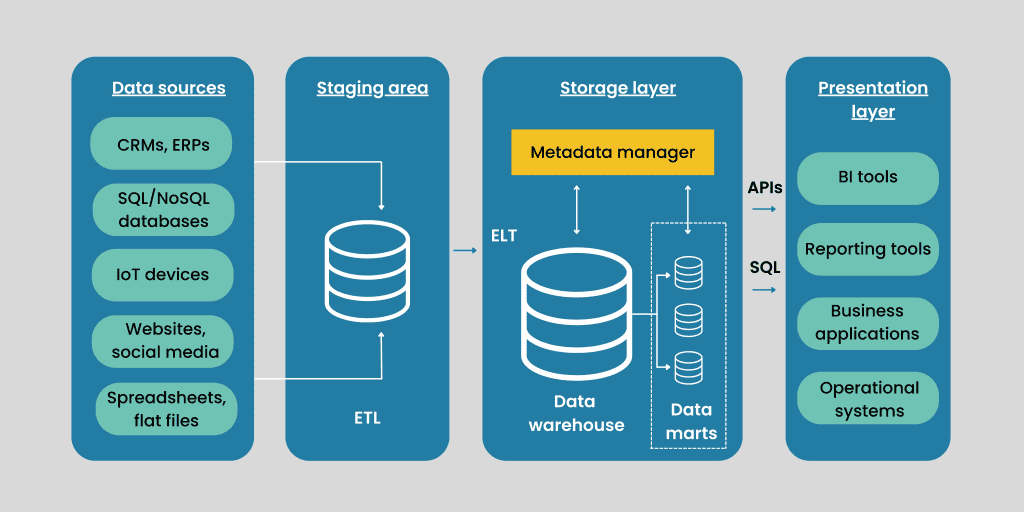
Key features of a data warehouse include:
- Centralized repository that combines data from multiple sources
- Use of ETL (Extract, Transform, Load) to clean, standardize, and prepare data for various use cases
- Stores current and historical data for trend analysis, comparisons, and forecasting.
- Standardization of data formats across the organization to help maintain consistency and accuracy
What benefits do data warehouses offer businesses?
Despite higher costs and scalability limits, data warehouses offer key benefits:
- Enhanced decision-making. Data warehouses deliver consistent, reliable insights that make it simple and easy to retrieve desired information. This speeds up data-driven decision-making.
- Better data quality. Data warehouses use ETL to improve data integrity and reliability.
- Improved query performance. Structured data enables faster, more efficient queries.
- Built-in security and governance protocols. Data warehouses usually don’t require additional governance protocols
What is a data lake?
Data lakes store raw data in native formats without a predefined schema. In addition to structured and semi-structured data, data lakes can also accommodate unstructured data.
Key features of a data lake include:
- Data lakes store text, images, audio, video, and more.
- Schema-on-read lets users define structure at query time.
- High scalability and ability to handle large volumes of data
- Supports real-time and batch ingestion with organized storage layers.
- Data processing layer to transform, clean, and convert raw data into suitable formats for analysis
- Mixed-workload support
- Built-in optimization techniques like parallel processing, caching, and indexing
What benefits do data lakes offer businesses?
Data lakes vary in quality and may slow queries, but they offer key advantages:
- Scalability and flexibility. Data lakes handle large volumes and diverse data types well (e.g. ML reinforcement learning, where exploration is more important than exploitation)
- Higher cost efficiency. Data lakes use low-cost storage and open formats to reduce costs.
- Better data integration. Data lakes store diverse data without pre-processing.
- Improved accessibility. Data lakes centralize all data types and eliminate silos.
Data lake vs. data warehouse: a comparison
So now that we’ve walked through features and benefits of data warehouses vs. data lakes, here’s a quick summary of how the two compare:
| Criteria | Data Warehouse | Data Lake |
| Data structure | Highly structured and organized (structured and semi-structured) | Raw data (unstructured, semi-structured, and structured) |
| Schema | Schema-on-write: Structure is defined upon loading | Schema-on-read: Structure is applied upon access |
| Data quality | High data quality via ETL processes (cleansing, standardization) | Varies; raw data is stored, so additional processing may be needed |
| Query performance | Excellent performance for predefined, complex analytic queries | May require additional compute resources for optimal performance efficiency |
| Storage cost | Generally higher due to structured storage and indexing | Often lower due to open formatting |
| Governance & security | Strong governance, consistent data, and built-in security features | Requires additional governance layers; flexible but less controlled |
| Flexibility | Less flexible; requires predefined structure | Highly flexible; ingests data in its native format |
| Common use cases | Business intelligence, reporting, and historical analysis | Big data analytics, machine learning, and data discovery |
Data lakehouse: the best of both worlds?
To take advantage of the strengths that both data lakes and data warehouses have to offer, many of the major data cloud providers (Databricks, Redshift, BigQuery, etc.) offer a data lakehouse architectural approach. This approach is exactly what it sounds like: an architecture that leverages the strengths of each approach to address their respective limitations. Snowflake and Databricks illustrate the two starting points: one warehouse-first, the other lakehouse-first. Our Snowflake vs. Databricks comparison explains how those roots shape each platform today.
Some key features of data lakehouses include:
- Unified storage of structure, semi-structured, and unstructured data within a single repository
- ACID (atomicity, consistency, isolation, durability) transactions to ensure data integrity among concurrent users
- Implementation of predefined schemas to improve data governance and organization
- Use of open file formats and APIs, which allows for broader compatibility with various analytics and business intelligence tools
This approach brings together the structured approach of a data warehouse, but maintains the flexibility and scalability of a data lake. As a result, users can improve data quality through ACID transactions and schema enforcement, while adopting a less expensive approach to cloud object storage.
Final thoughts on data lake vs. data warehouse
As with just about anything in the data and IT space, there’s no one right answer to the question of which is better: data lake vs. data warehouse. Different organizations have different use cases and desired business outcomes, each of which will determine the best architectural approach to use.
Hopefully this article has given you a high-level understanding of the pros and cons of each approach. At the end of the day, the key factors in choosing a data cloud architecture are:
- Keeping costs from ballooning out of control
- Enhancing performance efficiency among applications and teams
- Ensuring comprehensive observability of all your platforms